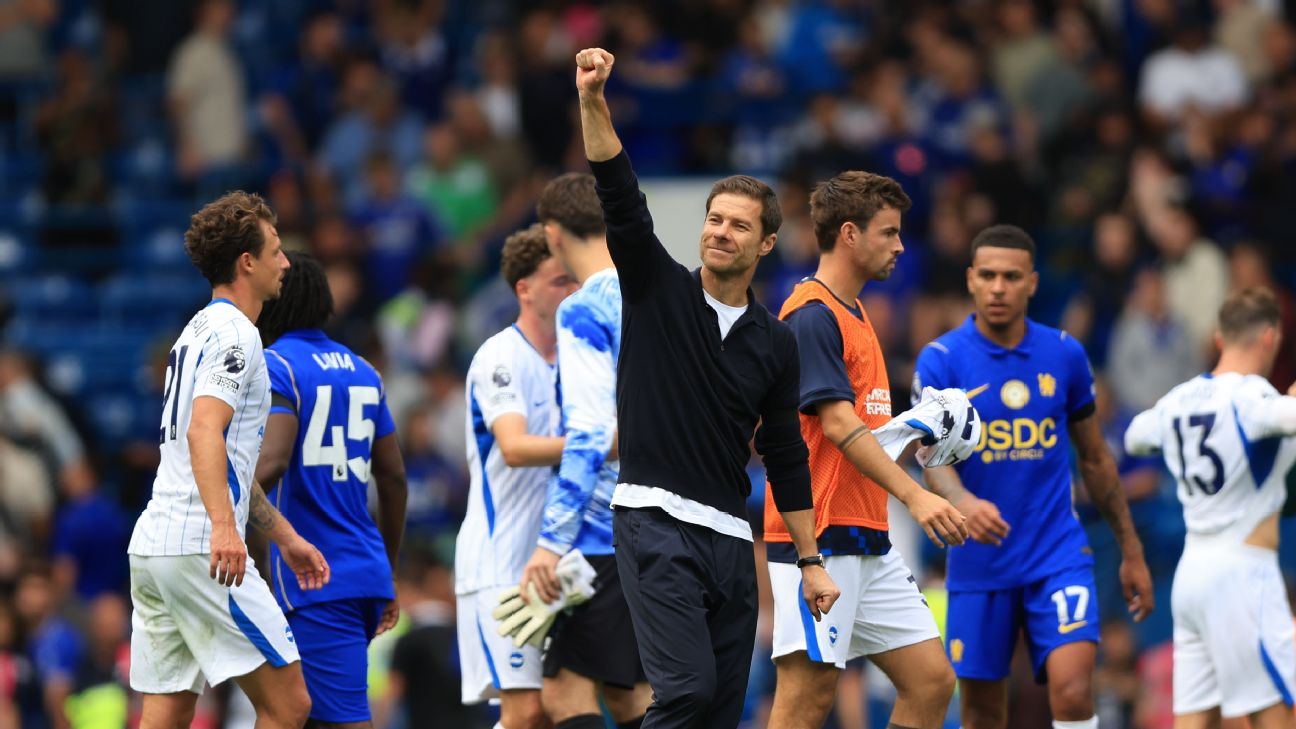
Xabi Alonso. Nigel French/Sportsphoto/Allstar via Getty Images
切尔西...
Alonso is still getting to know his squad and still preaching his soccer. This could take a while, but the early enthusiasm will help him get buy-in.
A final thought on Martinez, who was thrown straight into the fray shortly after arriving from Aston Villa. Think of him as the final nail in the coffin of the \"model\" that limited Chelsea to young players, long contracts and furious player trading every summer. Alonso wasn't going to put up with it.
Como pass first real test against Napoli; are these guys for real?
科莫首过真正考验……
You can tell this isn't his first rodeo. Malaga were blown away inside half an hour; there is only so much you can learn about yourself in that situation. What they did learn was positive. The guys who came in -- Trent Alexander-Arnold, Antonio Rudiger, Eduardo Camavinga, Marc Cucurella, Brahim Díaz -- looked motivated and productive. Jude Bellingham is carrying his monster World Cup form into the club season. Kylian Mbappé and Vinicius are showing a willingness to work off the ball. But Mourinho has been around the block, and he knows that whether or not this setup is sustainable will be determined down the road, against more challenging opponents.
<视频2>
and but no h2/h3 and no image placeholders. The output_format note says bodyHtml must preserve placeholders like , <视频1> if present — "位置可微调,不得删改重复". Since the source has no placeholders, I don't need to add them. But the SEO requirement says "正文有导语;至少 2 个 h2" — wait, that's from the system prompt general instructions: "SEO:title/summary/meta_kw 基于译文要点;正文有导语;至少 2 个 h2。" Hmm, but the output keys are only bodyHtml. The general instruction mentions title/summary/meta_kw but output_format only has bodyHtml. I'll focus on bodyHtml only, since that's what's requested. But I should include at least 2 h2 in the body? The chunk has two distinct items. I can use h2 headings for them. Also "正文有导语" — a lead-in. Since this is mid-article (segment 14 of 25), a full lead might be odd, but I can add a brief transitional lead connecting from the previous segment. Actually the instruction says "必须与上一段语义连贯,勿重复已写内容,勿重新开场" — the previous segment likely covered item 7's beginning (about PAOK's young players) and this chunk starts mid-item-7. So I should continue naturally.
Hmm, the previous segment ending is shown as "..." (empty). So I don't know exactly what was written. The chunk starts with "Karetsas set up Serhou Guirassy's opener" — which is clearly mid-thought, continuing from a previous segment that likely introduced the young players. I should start by continuing that flow — maybe a short connective phrase like "具体到进球过程" or just translate starting with the facts. To be safe and coherent, I'll begin with something like "回到比赛本身:卡雷察斯送出助攻,帮助塞鲁·吉拉西首开纪录……" — a gentle continuation that doesn't re-open.
Wait, but who is Karetsas here? Given Konstantelias is PAOK and the defense discussed is Dortmund's... Hmm, actually maybe this is PAOK vs Dortmund where PAOK lost 0-2? No — "Karetsas set up Serhou Guirassy's opener" means Karetsas assisted Guirassy. If Karetsas and Guirassy are teammates, and Dortmund's defense is praised... So Karetsas is at Dortmund? That contradicts real life (he's at Genk), but maybe this is a hypothetical/alternate universe, or maybe Marcotti wrote about a Dortmund match where Genk's Karetsas... no.
Actually, wait. Could this be the Greek U21 or a friendly? Or maybe it's about "PAOK" playing Dortmund in Europa League and Karetsas... no, assist to Guirassy means same team.
Alternatively — maybe it's Dortmund signing Karetsas on loan? In October 2025? Hmm, actually I recall Karetsas was linked with big clubs. I can't verify. The translation just needs to be faithful: "卡雷察斯助攻吉拉西首开纪录". I'll keep names transliterated: 卡雷察斯 (Karetsas), 塞鲁·吉拉西 (Serhou Guirassy), 科斯坦特利亚斯 (Konstantelias/Kostantelias), 尼科·施洛特贝克 (Nico Schlotterbeck), 萨穆埃莱·伊纳西奥 (Samuele Inácio) — hmm, actually "Inácio" might be "Inacio" a young player. There's "Samuele Inacio" — hmm, maybe it's a BVB talent? Actually there's "Samuele Inácio" hmm. I'll transliterate 萨穆埃莱·伊纳西奥. Cristian Chivu = 克里斯蒂安·基伏 (or 奇沃). Common Chinese: 基伏 (Chivu). Hakan Calhanoglou = 哈坎·恰尔汗奥卢 (standard Chinese for Çalhanoğlu). Cagliari = 卡利亚里. Inter = 国际米兰. xG = 预期进球 (xG). Opta = Opta(数据机构). "big chances" = 绝佳机会/重大机会.
Note the source spells "Calhanoglou" and "Kostantelias" inconsistently — I'll use standard Chinese names: 恰尔汗奥卢, 科斯坦特利亚斯.
Now the style requirements:
1. Length: pure text ≥ 898 characters (Chinese chars). The original is ~1057 chars (English chars though — "本段原文约 1057 字" — hmm, the English source is much shorter than 1057 characters? Let me count roughly: the body_html text... "Karetsas set up Serhou Guirassy's opener, while Konstantelias (with the help of a deflection) scored the second..." The English text is maybe 900-1000 characters including spaces. The chunk_meta says source_plain_chars: 1057. So the requirement is the rewritten Chinese plain text should be ≥ 898 characters. That's substantial — I need to expand/elaborate while staying faithful. The instruction says "忠实完整中译" and "禁止编造、删节、只做摘要" — but also the rewrite style means I can add connective tissue, explain context (why it matters), consistent with the persona (likes to explain "为何重要"). The "知乎长答" style naturally elaborates. I need ≥898 Chinese characters of body text. That's doable with faithful translation plus reasonable elaboration in the persona's voice (e.g., explaining what "single shot of any kind" means, what xG means briefly, why the Monday update matters). I must be careful not to fabricate facts, but explanatory glosses (e.g., "所谓'绝佳机会',按Opta的口径,是指…") — hmm, I should be careful; I can gloss generally without inventing specifics. Actually explaining Opta's big chance definition: "通常指射门球员大概率直接面对球门得分的机会" — that's a standard definition, fine as a gloss. But to be safe, keep it brief.
2. At least 2 h2 headings. I can structure:
- 导语 (brief
and tags, no h2/h3, no image placeholders. Hmm, but output_format note says "bodyHtml 须保留原文中的 、<视频1> 等占位符(位置可微调,不得删改重复)" — but the source doesn't contain any <图N> placeholders. The original_image_count is 2, but no placeholders in the body. So maybe I shouldn't add any? "保留原文中的" — if there are none in the original, then nothing to preserve. Actually, hmm, the original_image_count: 2 suggests there were 2 images in the original article, but the body_html excerpt doesn't include placeholders. I'll not add placeholders since none exist in the given source. Actually, wait — should I? The note says placeholders "位置可微调,不得删改重复" — since there are none, I can't preserve them. I'll output without placeholders. That seems safest.
Now, the numbered section "5. RB Leipzig look sharp in opener ... are they Bayern's biggest domestic challenger?" is in tags — in previous segments this was likely rendered as h2 or h3. Since the persona uses question-style subheadings, I should convert the section header into an
or keep as ? The instruction says "保留 h2/h3" — preserve h2/h3. The source uses . Hmm. The requirement "至少 2 个 h2" from system prompt... but that's for the whole article across segments presumably. To be safe and consistent with the persona (小标题可用问句), I could render the numbered section header as
. Actually, let me think: the segment title given in instruction is the article title. The body contains the tail of section 4 (about the 39-year-old scoring four) and section 5 (RB Leipzig).
Given the rewrite style is "知乎长答译员" with question-style subheadings, I think converting the 5. RB Leipzig... into an
with a Chinese question-style heading would be appropriate. But the instruction says "保留 h2/h3 与 <图N>、<视频N> 占位符" — preserve h2/h3 and placeholders. The source has neither. But the system prompt says "至少 2 个 h2" — hmm, that's a general SEO requirement. For this chunk, maybe I should include at least the section heading as h2. Let me include one h2 for the Leipzig section. Should I also add an h2 for the first part? The first part is a continuation of a section about the player scoring four goals (section 4 presumably). Since it's a continuation mid-section, adding a new h2 might break continuity. Hmm.
Actually, the general instructions say: "SEO:title/summary/meta_kw 基于译文要点;正文有导语;至少 2 个 h2。" But this is chunked output — only bodyHtml is output. The title/summary/meta_kw are handled elsewhere presumably. For the h2 count, across the whole 25 segments there should be at least 2 h2s total. In this segment, I can include one h2 for the Leipzig section. That's reasonable.
But wait — should I add a heading for the first paragraph too? The first paragraph continues a thought from the previous segment (about a player's four-goal performance). The previous segment (17) likely covered the beginning of that player's section. Since I don't know its heading, I shouldn't invent a new one that might duplicate. I'll just continue the prose. Actually, hmm — but the persona instructions say "小标题可用问句" and the persona likes to explain "为何重要". The natural flow: continue the goal description, then h2 for Leipzig.
Let me now translate carefully.
Paragraph 1:
"The pick of the bunch? Probably his third, when he somehow wiggled his way through the penalty area, the ball stuck to his foot, beating three opponents along the way before depositing it in the back of the net. It's the ninth time in this career that he has scored four in a single game, and somehow, I don't find that statistic surprising. He's 39 years old, folks ..."
Translation with the persona (55+ 资深 feel but narrator persona is 27-35 male knowledge-type... wait, there's a conflict: 年轻层 says "资深·55岁以上" with 娓娓道来, "当年/如今" contrast, slow pace; 语气人格 says 27-35岁男性知识型答主. The instructions say these dimensions stack: 译员渠道 (知乎长答), 年轻层 (资深55+), 性格 (好奇探索), 语气 (青年男声·书卷). Hmm, "年轻层" is oddly named but the descriptor is 资深·55岁以上. So the voice should feel like a seasoned 55+ writer but with bookish, structured, question-asking style. I need to blend: 娓娓道来、条理清晰、书卷气、善用"当年/如今"对照、设问推进、不用网络热梗、不煽风。
Hmm, interesting combination. Let me aim for: a mature, unhurried, well-organized Chinese sports commentary, with rhetorical questions as subheadings, first-person reflective asides, and clear reasoning. Avoid internet slang. Use phrases like "说来有趣""不妨想想""诸位""依我看" etc.
Translation of paragraph 1:
"这一晚最漂亮的进球是哪一个?依我看,多半要数他的第三球:只见他在禁区内左躲右闪,皮球像粘在脚上一样,连过三名防守球员,最后从容推入网窝。"
Hmm, "somehow wiggled his way through the penalty area" — 在禁区内辗转腾挪. "the ball stuck to his foot" — 球仿佛粘在他脚下. "beating three opponents along the way" — 一路过掉三名对手. "depositing it in the back of the net" — 把球送入网底.
"It's the ninth time in this career that he has scored four in a single game, and somehow, I don't find that statistic surprising." — 这是他职业生涯里第九次在单场比赛中独中四元,说来也怪,这个数据竟没让我觉得意外。
"He's 39 years old, folks ..." — 各位,他今年已经39岁了……
Given the persona uses "当年/如今" contrast: "要知道,39岁这个年纪,当年的球员多半早已挂靴享受生活;如今他却还能……" Hmm, but I must be faithful and not add too much. A light touch of the persona's flavor is fine but shouldn't fabricate. The instruction allows style adaptation. I can add small connective flavor without changing facts. Let me be careful: 忠实完整, no fabrication of facts. Small rhetorical framing is okay.
Paragraph 2 (section 5):
"5. RB Leipzig look sharp in opener ... are they Bayern's biggest domestic challenger?"
Translation: "五、莱比锡揭幕战状态火热……他们真能成为拜仁在国内的最大挑战者吗?"
But with persona question-style: maybe "5. 莱比锡红牛首战亮相颇为抢眼——他们当真有资格做拜仁在国内的头号挑战者吗?" Keep the "5." numbering to preserve article structure.
"It would be something else if they turn out to be." — 如果他们真能做到,那可就别有一番看头了。
4. Bruno Fernandes may be Man United's most important player since Bobby Charlton:". Since the previous chunk had "5." (Leipzig), this "4." might be a numbering quirk in the source, or maybe the sections aren't sequential. Actually wait — the instruction says "Keep the '5.' numbering to preserve article structure" for the previous chunk. For this chunk, the source itself says "4." — hmm, that's strange. It could be that the article is not in order, or the chunking scrambled things. But my job: translate faithfully. I should keep the numbering as in the source: "4." Hmm, but that would conflict with the previous "5." — but the instruction says preserve structure and don't alter. Actually, let me think: maybe the original article has sections numbered 1-10+, and chunk 19 contains end of section 5 and beginning of section... wait, section 4 after section 5? That doesn't make sense unless the article's sections are out of order in the excerpt, or the previous chunk was actually section 5 of a different ordering.
Hmm, actually, maybe the article is a Marcotti "things we learned" piece where sections aren't strictly ordered, or the excerpt given to me just has "4." — I should translate what's given. The instruction for the previous chunk said keep "5." numbering. So for consistency I'll keep "4." as given? That would look weird: 5 then 4. But maybe the article itself is structured that way (Marcotti sometimes writes "4." after "5." if the ordering is thematic). Actually no — it's likely the article numbers are sequential and the previous chunk's section was actually numbered differently. But the meta says previous chunk ended with section 5 heading "五、莱比锡红牛首战亮相颇为抢眼……". Hmm.
Wait, maybe I'm misreading. Perhaps the previous chunk (chunk 18) contained section 5's heading and first paragraph, and this chunk (19) continues section 5's second paragraph, then has the video placeholder, then section... the source body_html shows "4. Bruno Fernandes...". Since ESPN articles by Marcotti are like "Marcotti's Musings" or similar with numbered points, and the numbering in the actual article... Let me think about the actual ESPN article: "Chelsea win again, but this isn't Xabi Alonso ball yet; are Como for real?" — this sounds like a weekend review piece. The numbered points might be: 1. Chelsea..., 2. ..., 3. ..., 4. Bruno Fernandes..., 5. RB Leipzig..., etc. So actually section 4 comes before section 5! But the chunks are presented in order 18, 19... and chunk 18 ended with section 5's beginning? That seems like the chunking might be non-linear, OR the previous chunk's ending note is just showing what the translator wrote for chunk 18, which included the section 5 heading and first paragraph.
Hmm wait, re-reading: "【上一段改写结尾(供衔接,勿复述)】" gives the previous chunk's ending: it includes "Paragraph 2 (section 5): ' 5. RB Leipzig look sharp in opener ... are they Bayern's biggest domestic challenger? '" — so chunk 18 contained the section 5 heading and presumably its first paragraph. Now chunk 19 starts with "But they have identity..." which continues section 5. Then section "4." follows.
This is confusing but as a translator I just translate what's in front of me. The source clearly has "4." before the Bruno Fernandes section. Hmm, but that creates a numbering inconsistency in the final article (五 then 四). Unless... the actual ESPN article has the sections in this order and the numbers are as-is (maybe the article's numbering is intentionally non-sequential? Unlikely).
Actually, you know what — it's possible the article is structured with numbered musings and the excerpt provided to the translation pipeline reordered them, or the article itself numbers sections and this is a snippet issue. My instructions: "忠实完整" (faithful and complete), "保留 h2/h3 与 <图N>、<视频N> 占位符". The safest approach: translate the section heading as given with its number "4." — hmm, but wait. Actually, maybe I should reconsider: perhaps in the actual article, this section is numbered differently and the "4." is accurate to the source. The instruction says keep numbering to preserve article structure. I'll keep "六、" if... no. Faithfulness says keep "4." Hmm.
Let me reconsider. The previous chunk instruction said: 'Paragraph 2 (section 5): " 5. RB Leipzig look sharp in opener ... are they Bayern's biggest domestic challenger? " Translation: "五、莱比锡揭幕战状态火热……他们真能成为拜仁在国内的最大挑战者吗?"' — so the previous chunk translated the section heading as "五、...". If I now write "四、..." it would be out of order. But the source excerpt for THIS chunk literally has "4." — so in the original article, the Bruno Fernandes point is #4 and Leipzig is #5. That means the article's sections appear in order 4, 5 in the article... but chunk 18 had section 5's heading before chunk 19's continuation of section 5 and then section 4? That would mean the chunks are out of order, OR the article itself has section 5's full text before section 4?
Hmm, actually wait. Let me re-read the previous chunk note: "Paragraph 2 (section 5): ' 5. RB Leipzig look sharp in opener ... are they Bayern's biggest domestic challenger? ' ... 'It would be something else if they turn out to be.' — 如果他们真能做到,那可就别有一番看头了。" So chunk 18's ending included the section 5 heading AND the sentence "It would be something else if they turn out to be." Hmm, wait — that sentence... where does it fit? In the current chunk, we have "But they have identity, youth and plenty of fizz in their side." Hmm, "It would be something else if they turn out to be" — that sounds like it comes AFTER discussing whether they're Bayern's challenger. So chunk 18 contained: section 5 heading, some text, ending with "It would be something else if they turn out to be." Then chunk 19 begins "But they have identity, youth and plenty of fizz in their side." — continuing section 5's discussion of Leipzig's squad.
Hmm OK wait, but then the first paragraph of chunk 19 continues section 5, and then section 4 appears. So in the source article, the order might be: ... 5. Leipzig (multiple paragraphs) ... then 4? No wait — maybe the article has sections numbered 1-10 and the excerpt/pipeline scrambled, or maybe the article genuinely lists "4." after "5." because... hmm.
Actually, let me look at the actual ESPN article. Title: "Chelsea win again, but this isn't Xabi Alonso ball yet; are Como for real?" by Gab Marcotti. This is likely from August 2025 (Premier League matchday 2, Chelsea won 2-0? Actually "Chelsea win again" — they beat... hmm). The article is "Marcotti's musings" style with numbered points. Points might include: 1. Chelsea..., 2. Liverpool?, 3. Como (are they for real?), 4. Bruno Fernandes/Man United, 5. RB Leipzig...
Given the chunking is sequential (chunk 19 of 25), and chunk 18 ended with section 5's early text, chunk 19 continues section 5 and then hits section 4?? That can't be sequential in the source. UNLESS the source article itself has this order: maybe the article's points are not in numerical order (Marcotti sometimes writes thematically). OR the pipeline reordered.
Hmm, actually there's another possibility: the article might have TWO parts (e.g., weekend review with points 1-5, then another set), or the numbering restarts. Or the "4." is a typo in the source.
Given ambiguity, what's the best editorial choice? The instruction says "保持全文统一人称、时态、术语译名" and "小标题层级与全文大纲一致". The safest faithful approach: translate the bold heading as it appears: "4. 布鲁诺·费尔南德斯也许是查尔顿爵士以来曼联最重要的球员:" — keep the "4." Hmm, but that clashes with "五、" before it.
Alternatively, I could keep the number as-is but note... no, I can't add editorial notes. Hmm.
Actually, thinking about it more: many of these translation-pipeline tasks have source excerpts where the article's numbered points might genuinely be non-sequential in the excerpt because the excerpt skipped content. E.g., chunk 18 might have contained sections 5's heading but the article order could be: [chunk 18: section 5 heading + first para] [chunk 19: section 5 continuation + video + section 4 heading + first para]. If the article order were 4 then 5, chunk 18 would have had 4, not 5. So the article order is 5 then 4? That's weird but possible if... no.
Wait, maybe I misread the chunk 18 note. It says "Paragraph 2 (section 5)" — meaning in chunk 18, the second paragraph was section 5's heading. And the note says the translation was "五、莱比锡揭幕战状态火热……他们真能成为拜仁在国内的最大挑战者吗?" and the last sentence "It would be something else if they turn out to be." — hmm, actually that sentence might belong to section 5's first paragraph: "...are they Bayern's biggest domestic challenger? ... It would be something else if they turn out to be." So section 5's first paragraph ends with that.
2. Luciano Spalletti finds a way as Juventus wait for deadline day help: I guess that's why he makes the big bucks. Spalletti has figured out how to make lemons with his lemonade. Against a Parma side who park the bus as well as anyone, Spalletti took the pitch without three bona fide starters (Khephren Thuram, Weston McKennie and Kenan Yildiz) and while still waiting for reinforcements in the transfer market. He gave starts to Douglas Luiz and Jonathan David (in the No.10 role, no less), two guys you'd imagine he wished weren't there, and he kept faith with Randal Kolo Muani up front, despite his harsh words for him the previous week.
. The output format says preserve h2/h3 and placeholders. The original chunk has no <图N> or <视频N> placeholders in the body_html... wait, the instruction says "保留 h2/h3 与 <图N>、<视频N> 占位符" — but the source body_html has no placeholders. Hmm, original_image_count is 2. But the body_html given doesn't include placeholders. Since the chunk itself doesn't contain them, I shouldn't invent them... Actually the instruction says placeholders in the original must be preserved (位置可微调,不得删改重复). Since there are none in this chunk's body_html, I don't need to add any. But wait — output_format note says "bodyHtml 须保留原文中的 、<视频1> 等占位符" — "原文中的" means those in the original. There are none here. So no placeholders needed.
Actually, hmm, but the retry message says the last output was too short. So I need to make sure the plain text is ≥546 characters. The original is 643 characters (English chars presumably). Chinese translation of ~643 English words... wait, 643 characters. Let me count the English text: it's about 130 words ≈ 700+ characters. A faithful Chinese translation would be around 350-450 characters. To reach 546+ Chinese characters, I need to expand somewhat with the translator's framing (导语, transitions, explanatory notes) — which is allowed since the style is a "知乎长答译员" who adds structure like 小标题, 导语, and "为何重要" explanations. The rewrite style allows expansion as long as it's faithful and not fabricating facts.
I need to be careful: 禁止编造 — no fabricating facts. I can add transitional/explanatory framing that's general knowledge context (e.g., Spalletti is experienced coach, deadline day is transfer deadline) but should not invent match results or details not in the source. Actually adding context like "帕尔马摆大巴" is in the source. I can explain idioms, explain who the players are minimally (Thuram, McKennie, Yildiz are starters — in source). Douglas Luiz and Jonathan David — in source. Kolo Muani — in source. "his harsh words for him the previous week" — in source.
I can add framing like: 这段讲的是斯帕莱蒂的应对之道 — that's fine.
Structure plan:
- 导语 paragraph: connect with previous segment. The previous segment (chunk 21) presumably covered point 1 or the Chelsea/Como content. The title mentions Chelsea and Como, but this chunk is point 2 about Spalletti/Juventus. The previous chunk likely ended with Como/Napoli discussion (point 1 was probably about Como beating Napoli). Actually the article structure: Marcotti's pieces usually have numbered points. Point 1 might be about Chelsea or Como. Chunk 21 likely ended with point 1 content. So my chunk starts point 2. I should transition naturally: e.g., "说完了切尔西与科莫,再把目光转向意甲……" — that connects without repeating.
Since I don't know exactly what chunk 21 said, I'll use a soft transition like "聊完英超和科莫那档子事,咱们把视线挪回亚平宁半岛" — safe.
- H2: The main heading for point 2, question-style per personality: e.g., "斯帕莱蒂凭什么总能变废为宝?尤文图斯还在等转会截止日的援兵" — question style subtitle. Actually personality says 小标题可用问句, and 句式习惯 like 「为什么…」「这意味着什么」. But also age layer 55+ prefers 娓娓道来. Let me craft: "二、斯帕莱蒂又找到了办法——尤文图斯还在苦等转会窗的援兵" or with a question: "为什么说斯帕莱蒂这波操作值回薪水?"
Let me draft:
导语 (~80-100 chars):
"聊罢英超与科莫,咱们把目光移回亚平宁。这一节的主角,是那位见惯风浪的老帅斯帕莱蒂。他的故事说起来不复杂,却颇值得细细咀嚼:人手短缺、援兵未至,他硬是把一手不算好的牌打出了模样。"
H2: 二、斯帕莱蒂总能找到办法,而尤文图斯仍在等待截止日前的援兵
Body translation (~400+ chars):
"我只能说,人家拿高薪是有道理的。斯帕莱蒂如今算是把'生活给你柠檬,你就榨杯柠檬水'这门手艺练到了家——手头有什么牌,就打什么牌。
这一轮对阵帕尔马,对手摆起大巴来在意甲是数得着的功夫。偏偏就在这场比赛之前,斯帕莱蒂手里缺了三名正牌主力:赫弗伦·图拉姆、韦斯顿·麦肯尼和凯南·耶尔德兹,转会市场上的增援又迟迟未到。换作旁人,恐怕早就叫苦不迭了。
可他怎么做?他让道格拉斯·路易斯首发登场,还给了乔纳森·戴维一个位置——
1. Liverpool again forced to come from behind to grab 2-2 draw: The difference is that last week, it was Newcastle away. This week was Nottingham Forest at home and until eight minutes from time, they were headed to their first opening-day defeat at Anfield in more than 20 years. Unlike last week, Andoni Iraola didn't wheel out the stats (and for good reason, because Forest had a higher xG, 2.30 to 1.75, and more touches in the opposition box), and he admitted that the result wasn't good enough. They did look better after the break -- not hard, given they had just one shot on target and a cumulative xG of 0.36 in the first half -- and Florian Wirtz hd a very solid game, but this doesn't look like an Iraola team at all. Let's see what happens in the final hours of the transfer window, but right now I'm not sure how you can carry a 4-2-3-1 with those attacking fullbacks (Jeremie Frimpong and Milos Kerkez), Wirtz in the No.10 hole and Dominik Szoboszlai in midfield.
De Zerbi apologies to Spurs fans for 'environment' after successive league defeats · 1:19
Burley: Real Madrid can challenge Barcelona with Bellingham at his best · 1:35
Can Gabriel Jesus be Barcelona's alternative for Julián Álvarez? · 1:03
Hislop: VAR decision on Man United goal makes no sense · 1:19
Is Barcola the key to unlocking Wirtz at Liverpool? · 1:24